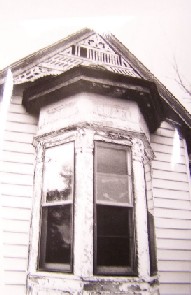

The Devil Queen

How my wife and I sold our souls to the Queen Anne Victorian we tried to save.

My Photo
Name:
Location: Crow Mountain, Arkansas, United States

Synopsis: This is a cautionary tale. A seriously disturbed couple find the charming, old ruin of a Queen Anne Victorian in Russellville, Arkansas, and buy it for $1.00. They tore the roof off, cut it in half, and had it moved to some land they owned sixteen miles away because they didn't know any better. Since then, they have hired and fired contractors, had all of their tools stolen, re-wired, re-plumbed, insulated, and essentially rebuilt the entire house. Their only problem is that after four years it still isn't finished. Now they are tired, broke, and wonder what in the hell it is they've done to themselves. And, it's haunted.
(Last updated on April 3, 2008)

Press: Russellville Courier Article - December 2003, HGTV website article, AP story - October 2006, and Victorian Homes Magazine - February 2008 (link coming soon).
Art: From time to time, I receive requests for my art. If you would like to look at more of my art, go to The Failed Artist. If you would like to buy my art, email me. I am more than happy to answer any questions you might have. Thanks!

Thursday, December 13, 2007

Dim Sum


Home improvement is a stressful hobby which requires a tool box full of coping mechanisms to help you survive. People turn to any number of things to help them cope: shopping-therapy, weekend vacations, denial, jogging, yoga, electroshock therapy or raging alcoholism. There really is something for everyone. My new favorite it Chrysanthemum tea. Here is an except from the Wikipedia article on it:


"Chrysanthemum tea is a flower-based tisane made from chrysanthemum flowers of the species Chrysanthemum morifolium or Chrysanthemum indicum, which are most popular in East Asia. To prepare the tea, chrysanthemum flowers (usually dried) are steeped in hot water (usually 90 to 95 degrees Celsius after cooling from a boil) in either a teapot, cup, or glass; often rock sugar is also added, and occasionally also wolfberries.photo The resulting drink is transparent and ranges from pale to bright yellow in color, with a floral aroma. In Chinese tradition, once a pot of chrysanthemum tea has been drunk, hot water is typically added again to the flowers in the pot (producing a tea that is slightly less strong); this process is often repeated several times."


I've never had the tea with sugar or wolfberries, so I can't vouch for them. The flavor of the tea is hard to describe. It is very light and smooth with slightly sweet floral taste (no where nearly as robust as chamomile tea for instance).

At first, I thought the ritual of making and drinking the tea was why we felt so good afterwards. I did some research though and the tea has some medicinal properties too:

"Chrysanthemum is taken as a headache remedy, and for dizziness and hearing disorders. It is also used for treating high blood pressure. Chrysanthemum is used as a compress or eye wash for inflammation of the eyes and for other eye problems such as dry-eye, blurred vision, and seeing sports. It also has a calming effect and can relieve stress. Combined with honeysuckle, it can be used for treating colds, flu, fever, and infected sores. A poultice of Chrysanthemum leaves works well on acne, pimples, boils, and sores.In the 1st century AD, Chrysanthemum was categorized in the Shennong Bencao jing (Herbal Classic of Shennong) as a medicine, particularly for use as an anti-inflammatory, but it also has antiseptic and antibiotic properties."


I have also read that some scientific testing has indicated that it may also have some anti-cancer properties. Granted, all of this research of mine has been done with online sources, so you may want to take all of this with a grain of salt. However, I would say that in general it's good for you.

Scarlet and I were introduced to Chrysanthemum tea at Chi's Chinese Restaurant in Little Rock. It wasn't a menu item either. I think the wait staff (mostly Chinese college students from abroad) was impressed with our willingness to try anything on the dim sum menu. The translation of some of the dishes into English was splotchy at times, but this would include dishes of "ox-tail," and "cow stomach." At some point, they quit serving us the generic "Chinese Restaurant Tea" and slipped us the Chrysanthemum. They seemed inordinately pleased that we liked it. I guess most Arkansans are not into hot, herbal teas?

Speaking of good Chinese food, does anyone one know of a good Chinese restaurant which serve dim sum in or near Arkansas? Our old favorite, Chi's, recently was sold to new owners, and they promptly did away with the dim sum menu in their rush to join the all-you-can-eat Chinese buffet bandwagon. Suggestions?

Labels: ,

Thursday, March 29, 2007

Coming to Terms with Paint Removal

I find the first hour of any involved home improvement project is the worst. It takes a lot of will power and effort to ignore the couch's siren call, the lure of insipid, mind-numbing television, or a long, intoxicated soak in the tub. If you can actually start the project, then you have to work at getting into the groove of what you're doing. Every task has its own rhythm and until you find it everything is a mess. But, once that first horrific hour has passed, you find your body moving in a relentless mechanical rhythm (unless you're doing plumbing or anything involving exact measurements). This is great because your mind can drift far away for a while.

I spent a lot of time doing my paint scraping dance on the top of a ten-foot step ladder the other night, and I couldn't help but think of poor Chris. In particular, there was this comment he left on a previous post:

"I'm having to swiftly come to terms with the idea of dry scraping as I'm going to have to do it to all of the exterior woodwork of the house. Any suggestions you have in terms of process would be hugely helpful I'm sure."

My first thoughts were pretty knee jerk. You know, the stuff most people would think of using for a project like this: hard liquor, hookers, and lots of wasp spray - unless they have something else in Canada. I don't know what you'd use to take care of a nest of Grizzlies roosting up on the eaves. A Gatling Gun maybe?

But, once I got past these superficial suggestions, I dug deeper into the philosophical meat of this problem. It occurred to me that there is one central fallacy around which everyone bases their approach to paint stripping or scraping: that there is a good and easy way to strip off old paint.

The stark and central truth is there is no good way to strip paint. None.

No, actually I lied. If you have money to burn, you can hire a whole team of trained monkeys scrape your house clean and sit out in the yard under a shade tree drinking mint juleps and reading the newspaper. That is easy. Well, conditionally. We're assuming that the monkeys actually know what they're doing and come to work.

Each and every method of paint removal suck in their own way. What you have to find is the method you prefer to use, learn to do it well, and just get it over with. Divest yourself of the idiot dream, the Easy Way, and embrace the truth in all its filthy glory.

Over the years we’ve work on the Old Whore, we've experimented with a number of different paint removing methods: spray-on stripper, paint-on stripper, heat guns, UV strippers, sanders (hand sanding, orbital, random orbit, palm, etc), grinders, eco-friendly strippers, and dry-scraping. And, do you know what I've found? If I had spent all that time actually scraping paint and not dicking around with the newest path of enlightenment, I'd probably have finished long ago.

I find that all paint removal techniques have four components on which they may be rated: ease, mess, speed, and cost. I won't break these down any more than that (unless someone wants more detail), because they seem fairly straight forward to me. And, my final conclussion to date is: dry scraping is hard work but it is cheap, fast, and occasionally easy. The mess is unavoidable, just jump in and wallow in it.

One thing I have noticed is a correlation between ease and speed. For instance, a heat gun is pretty easy to use. You flip it on, heat the paint, it bubbles, and it glides right off with a pass or two of the scraper. But, compared to dry-scraping it is a very slow process. In my experience, dry-scraping goes roughly twice as fast (or more) for me, but it wears me completely out after a couple of hours. There is definitely a trade-off here.

Anyhow, here are my "big" dry scraping tips:

1) Use a scraper with a small blade. Sure, it will take more passes to strip the paint, but I find that they are easier to control (fewer gouges) and you can exert more pressure because of the smaller surface area.

2) Sharpen your scraper often. Depending on how tough the paint it, you may find it necessary to sharpen your blade every 5 to 10 minutes. It sounds like a hassle, but your muscles will thank you. It is soooooo much easier to scrape with a sharp blade.

3) Wear thick leather work gloves. If you are doing it indoors, wear a respirator or mask at the very least.

4) If possible, always go with the grain of the wood.

5) Manage your expectations. No matter how bad your paint is in, it will take a very long time to get it all off. Don't get discouraged, it can be done but it will take a while. Persistence counts.

6) Know when call in the big guns. Sometime you will find a section of paint that will not come loose no matter how much you dig at it. Save yourself some grief and time, and move on to Plan B. At this point, the heat gun is my back-up of choice. Unfortunately, since there are lots of gaps between boards into hollow walls full of 100 years worth of potentially flammable shit, I usually opt for spray-on chemical striper. Or, I might just take a sander to it and feather out the edges and paint over it anyhow. Below is a picture of some paint that would not turn loose on the foyer wall it. Took me longer to get it down to this than it did to scrape half of the foyer ceiling.


Now, as the final disclaimer, I will say that I haven't done too much exterior paint stripping, but, from what I can tell, all of the same principles apply. Also, you might check with Greg over at The Petch House. I can't remember for sure, but I believe he dry scraped the whole Petch House.

Hope this helps Chris. And, good luck.

Labels: ,

Free Web Site Counter
Website Counter